






Introduction
Every domain owner eventually faces questions such as:
As an ICANN accredited domain registrar, Nicenic will explain the entire lifecycle clearly from a professional industry perspective.
Section One:The Four Core Domain Operations
Every domain action belongs to one of these four categories.
The user obtains the right to use a domain for a chosen period.
Domain Renewal
Extends the registration term. A domain can be renewed up to a total of ten years in advance.
Domain Transfer
Moves a domain from one registrar to another. This requires an authorization code and approval from the losing registrar.
Update
• Enabling or disabling privacy service
• Enabling or disabling transfer lock
Different parties participate in each operation in different ways.
| Operation | Registry | Registrar | Registrant |
|---|---|---|---|
| Registration | Creates domain in zone | Provides registration service | Submits registration |
| Renewal | Extends registration term | Processes renewal request | Pays for renewal |
| Transfer | Confirms transfer validity | Executes transfer steps | Requests transfer |
| Update | Writes final data into root zone | Submits update to registry |
Requests change |
Section Two: The Complete Domain Lifecycle
↓
Deletion and becomes available for registration again
Stage One: Registration
Immediately after registration, the domain is active.
Key facts
Why registration cannot be refunded
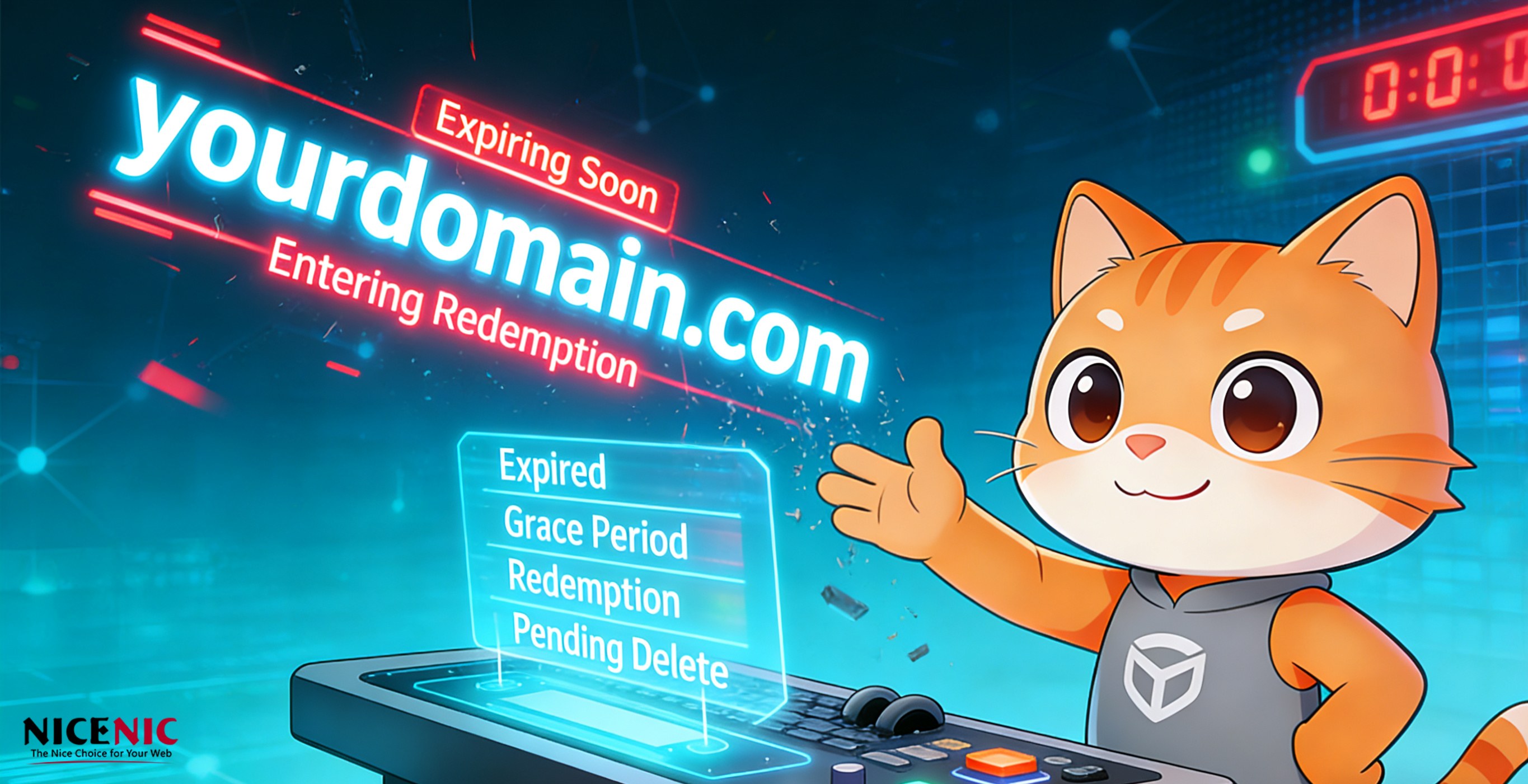
Stage Two: Expired
If the user does not renew before the expiration date, the domain becomes expired.
During this period
Expiration behavior varies by registrar because this part is operational practice, not ICANN policy.
Stage Three: Grace Period
The grace period usually ranges 0-45 days depending on the registry.
Characteristics
Why some country extensions have no grace period
Country code registries operate independently and set their own rules. Examples include UK, DE, JP and others.
Stage Four: Redemption Period
If the domain is not renewed during the grace period, it enters redemption which usually lasts 30 days.
Characteristics:
Why redemption costs more
Stage Five: Pending Delete
After redemption ends, if the domain is still not restored, it enters pending delete for 5 days.
During pending delete
This is why users sometimes say:"I am willing to pay any cost, please help me restore the domain." But at this stage even the registrar has no authority.
Stage Six: Deletion and Re Registration
After deletion:
• Registry premium rules may apply
• Auctions or backorders may occur
Section Three: Domain Transfer Explained
There are two types of transfer:
Registrar Transfer
The common domain transfer performed by users
Why some domains cannot be transferred:
These rules exist to prevent domain theft and fraud.
Registry Transfer
Not related to end users. This happens when an entire TLD moves from one registry to another.
Section Four: Domain Renewal Essentials
Why renewal prices vary
Section Five: Registry and Registrar Authority Comparison
This table is extremely important because it clarifies why certain actions can or cannot be performed.
| Action | Registry Authority | Registrar Authority |
|---|---|---|
| Delete domain | Yes | No |
| Place domain on server Hold | Yes | No |
| Block domain transfer with server Transfer Prohibited | Yes | No |
| Adjust price | Yes | No |
| Restore redemption | Yes final decision | Yes submit request |
| Apply client Hold | No | Yes |
| Apply client Transfer Prohibited | No | Yes |
| Modify DNS | No | Yes |
Section Six: Answers to the Most Common Questions
❓Why can the registrar not unsuspend my domain
Because the domain is under server Hold which only the registry can remove.
❓Why can the registry change pricing
❓Why do premium domains have high renewal fees
Because the registry defines premium tiers which apply to every renewal.
❓Why some domains have no grace period
Because the registry’s policy for that extension does not include it.
❓Why expired domains cannot always be restored
Because once a domain enters pending delete, the registry blocks all recovery.
❓Why transfers sometimes fail
Section Seven: Why Nicenic Emphasizes Lifecycle Education
Understanding domain lifecycle helps users avoid serious risks such as
Conclusion
Nicenic will continue providing clear guidance, stable infrastructure, and professional support to every domain owner worldwide.
Next Neus: Domain Registry vs Registrar vs Registrant: Globales Domain-Modell verstehen